


Let’s Fix The Big Ten Tournament
[Ed. Note: First off, I know, I know, actually written content. Make your jokes, go on, get it out of your system. If you’re reading this you’re probably a longtime visitor because anyone who became aware of us in the past five years (or more) doesn’t remember when we did this.]
Do you know anybody who actually likes the Big Ten Tournament? Sure, there are probably some midwestern moms who love the idea of doing a little crocheting while Penn State and Northwestern brain each other with bricks on a Wednesday lunch hour, but for the most part, people see the Big Ten Tournament as….kinda stupid.
Until 1998, the Big Ten said no, we don’t need a tournament. The regular season conference champ got the auto-bid and among the rest, if you were a decent Big Ten team, you were getting an at-large bid.
Then, of course, the final holdouts eventually caved (I think the Ivy was the last holdout) and the money grab was on. The problem, of course, is that the Big Ten Tournament is rarely every compelling. This is true of most power conference tournaments. When it comes right down to it, the top of power conferences are just too good. If one of the biggest of the big boys stumbles, there are a handful of teams right under them who are good enough to snatch it. Never does a lower-tier team “go on a run” and make it happen like you might see in the mid-majors or below.
The Big Ten tournament began in 1998 and we’ve seen one 8-seed (2017 Michigan, who was not at all a bad team, went 26-12 that year and went to the Sweet 16), one 6-seed (2001 Iowa), two 5-seeds and one 4-seed. The other 20-something were 1, 2 or 3 seeds.
The Big 12 tournament has been held since 1997. There has been one 5-seed who won it (Iowa State in 2019) and two 4-seeds. Otherwise, it’s been all top 3 seeds.
Kentucky has won the SEC tournament 32 times.
The other thing that’s always been true but especially in recent years – the committee has its mind pretty much made up on the first 20-25 seeds heading into that weekend. Winning the conference tournament never means much for power conference teams. Because everyone knows who the good ones are already and they know that these tourneys don’t really matter to these guys.
Players have recently even admitted they don’t care much about these tournaments, particularly if you’re on a team that already knows it’s going to the tourney that matters. So let’s make it better.
First question here: why the hell do we have these convoluted, byes and double-byes and now triple-byes? It leads to a bracket nobody understands. Do you know why the NCAA Tournament is so popular? The symmetry of the 64-team bracket. Everyone gets it, even casuals like Nebraska fans. So why does seemingly every conference tournament have some bananas bracket that either makes you laugh or makes your head hurt?
I guess the easy answer is it is providing a “reward” to the teams that finished at or near the top of the conference. Okay, I guess, but we don’t do that anywhere else in college basketball. We don’t do it in pre-season tourneys and we sure as hell don’t do it in the NCAAs a week later. The 1-seed doesn’t get a bye to the Sweet 16, do why do the equivalent here?
For a team like this year’s Purdue – currently the 5-seed in the Big Ten as of this writing – they’ll need to win four games to win the Big Ten Tourney. What will Michigan need to win? Three. So is that an advantage? Sure. But would one more game be a big deal? Of course not.
So let’s make this simple. Let’s make this an actual dry run for tournament play in March and set it up like an NCAA Regionals. 1-16, seeded accordingly. Yes, in the Big Ten there are 18 teams. If you want to eliminate the bottom two to make it 16, I mean, I sure don’t care. Hell, I’m fine reducing the number by a bigger chunk (more on this later). But for now, let’s just assume they want everyone involved.
For those final two seeds, you do the NBA’s little play-in nonsense and you have the 15-18 seeded teams fight it out for those spots. The 15-16 winner gets the 15 spot against the 2 and the 17-18 gets the slot against the 1. Now you’ve got a bracket that looks like an NCAA Regional.
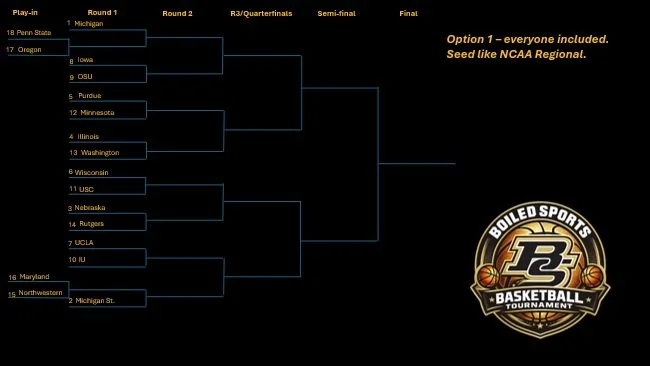
So what does this do? Well, it makes the first full day actually compelling. You’ve got the best teams all playing games and you’ve got some matchups you wouldn’t have under the current setup. Right now, on the second day you get the winner of 16-17 against 9. Then you get 12 vs 13 and then the winner of 15-18 against 10. What a snooze of horseshit basketball.
In our version, look at the first full day. You get Iowa-OSU…Purdue-Minn… UCLA-IU! Actually somewhat compelling games. And if you’re a Michigan fan, you get to see them lay the wood to somebody. Everybody loves seeing their team do that.
(Incidentally, for that play-in round, I would advocate for doing that on the campus of the higher seed. It gives it an NIT-like feel, gives the fans another home game, doesn’t give you a day of crap at the conference tourney site…lots of positives.)
Then the second day, let’s assume the higher seeds move on. You’ve now got Michigan/Iowa, Purdue/Illinois, Wisconsin/Nebraska and UCLA/MSU. Obviously, as this moves along it gets better and better. And it has the added bonus of being easy to understand and a true primer for the NCAA tourney.
But what if we got crazy?
Aneesh and I advocated – and I’ve pushed this idea for a while – on the Basketball Beat this week for just lopping off the top four (or more) teams from the conference tournament. You want to reward them with having to play less basketball? Then fine, make them play none that week. If you’re a top-4 team in the Big Ten, you’re going to the tourney. And as noted above, you’re not materially affecting your seed in three BTT games. Your body of work is what it is at this point. So there’s really no downside for them.
So now you’ve got the 5-18 teams remaining. What do we do now? Well, that’s only 14 teams but you can still slot this into a logical, NCAA Regional-like bracket. You just move everyone up in seed – #5 Purdue becomes the 1, #6 Wisconsin becomes the 2, and so forth. And for the missing 15 and 16, your only option is to indeed provide a bye. However, it’s only a bye for the top two teams in this tournament and it’s over hypothetically bad teams so big deal. Here’s what it would look like.
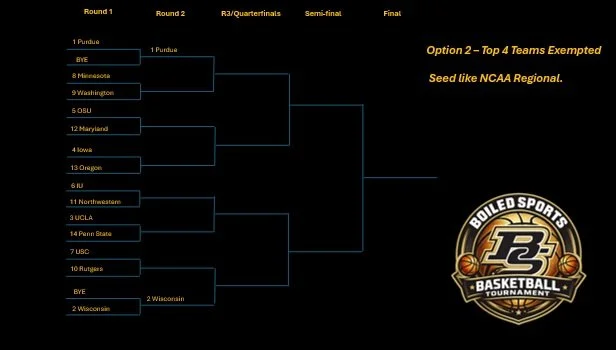
This jumbles the matchups again but in a good way. In getting rid of the powerhouse teams for any given Big Ten season, you now have a tournament that feels more open. Look at these matchups and try to tell me that OSU or UCLA couldn’t win this thing. Hell, could a feisty Minnesota? Probably not, but feels a hell of a lot more possible now.
I had someone ask if you could award the conference’s auto-bid to the winner of this kind of tournament that doesn’t include all the teams. Sure, why not? Last year they didn’t invite all the teams. And it’s up to each conference as to how they award their bids. Until ’98, the Big Ten gave it to the regular season champ. So now they can just say they give the auto-bid to the winner of this. Hell, if those wacko conferences with the “gauntlet” style brackets can do it that way, clearly anything goes.
Let us know what you think.